I think the film is successful in how it portrayed the protagonist as an anxious and unstable character. We started thinking about experimental ways in which we could
convey the protagonists discomfort, anxiety and structure of life. Repetition
of locations, scenes and sounds (tapping noise) are repeated throughout to
establish the repetitive nature of her life, journeying on trains, lifts and
through the urban environment on a daily basis. The narrative in nonlinear and
cuts to flashbacks, such as in the lift. The sound remains in the present yet
we see somewhere else, showing the protagonists mind wandering and allowing the
viewer a glimpse of her minds eye. Sounds bring her back to reality, conveying
her anxious mind. The camerawork also reflects her mental state: At the
beginning, and in her flashback in the lift, her calmness is reflected through
static and slow tilt
and pan tripod
camerawork. Elsewhere, shouldercam footage Creates a loose, slightly uneasy
aesthetic, and in the train station, train and street, handheld and handheld
'lens whacking' Camerawork is used. I borrowed this technique from
Mulholland Drive (2002, David Lynch) and the TV show
This is England 90 (2015, Shane Meadows).
This created a rushed, unstable, anxious and
drunken image. In these scenes we used faster cuts and sped up some footage to
500% to further heighten the pace of the scene.
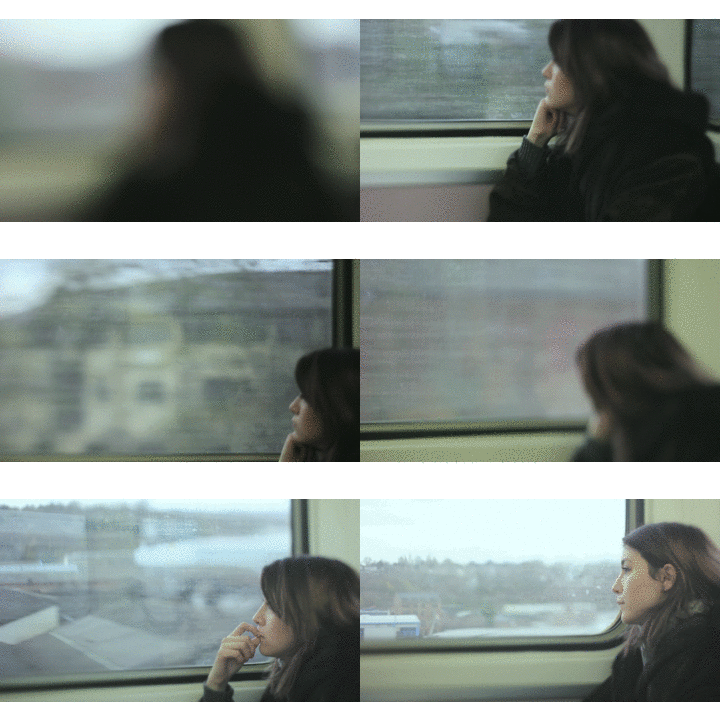
We shot on a Canon EOS 70D and
550D, giving us good depth of field and low noise during the night scenes. We
used an 11-16mm f2.8, a 50mm f1.4 and a 58mm f2 lens. The former gave us
distorted wide angles and the ability to zoom, and the later 2 allowing for narrow depth of field and lens whacking. We created and applied a digital
filter to resemble the bleach bypass effect, used on films such as Seven (1995, David Fincher).
As Natalie was acting in the film, I did most of the camerawork,
but we both planned, filmed and edited together. Because we used a very loose narrative structure, the film was quite confusing
and didn’t seem to flow too well. The range of camerawork styles and locations
also made the overall aesthetic quite inconsistent. If I were to film it again,
I would make the colour scheme and camerawork more consistent to give the film
a clearer aesthetic.
The film taught me a lot about filming in busy public locations;
we had to acquire permission to film at the train station and not use lighting,
tripods higher than 6ft or film 3-4ft from the platform edge, which thankfully
didn’t effect our film.
We took inspiration from
Amélie
(2001, Jean-Pierre Jeanet) in how it characterizes the protagonist Amélie
Poulain, however we gave our film a much darker, grimmer aesthetic. We were
also inspired by
Fish Tank (2009,
Andrea Arnold) in it’s use of colour and camerawork.


I was also inspired by the
short films
Salaryman 6 (Jake Knight, 2002) and
Beat (2013, Aneil Karia)
and how they conveyed the protagonist (with little or no dialogue from them) as a social
outcast and potentially struggling with their mental health, and how they portrayed the urban environment visually.


